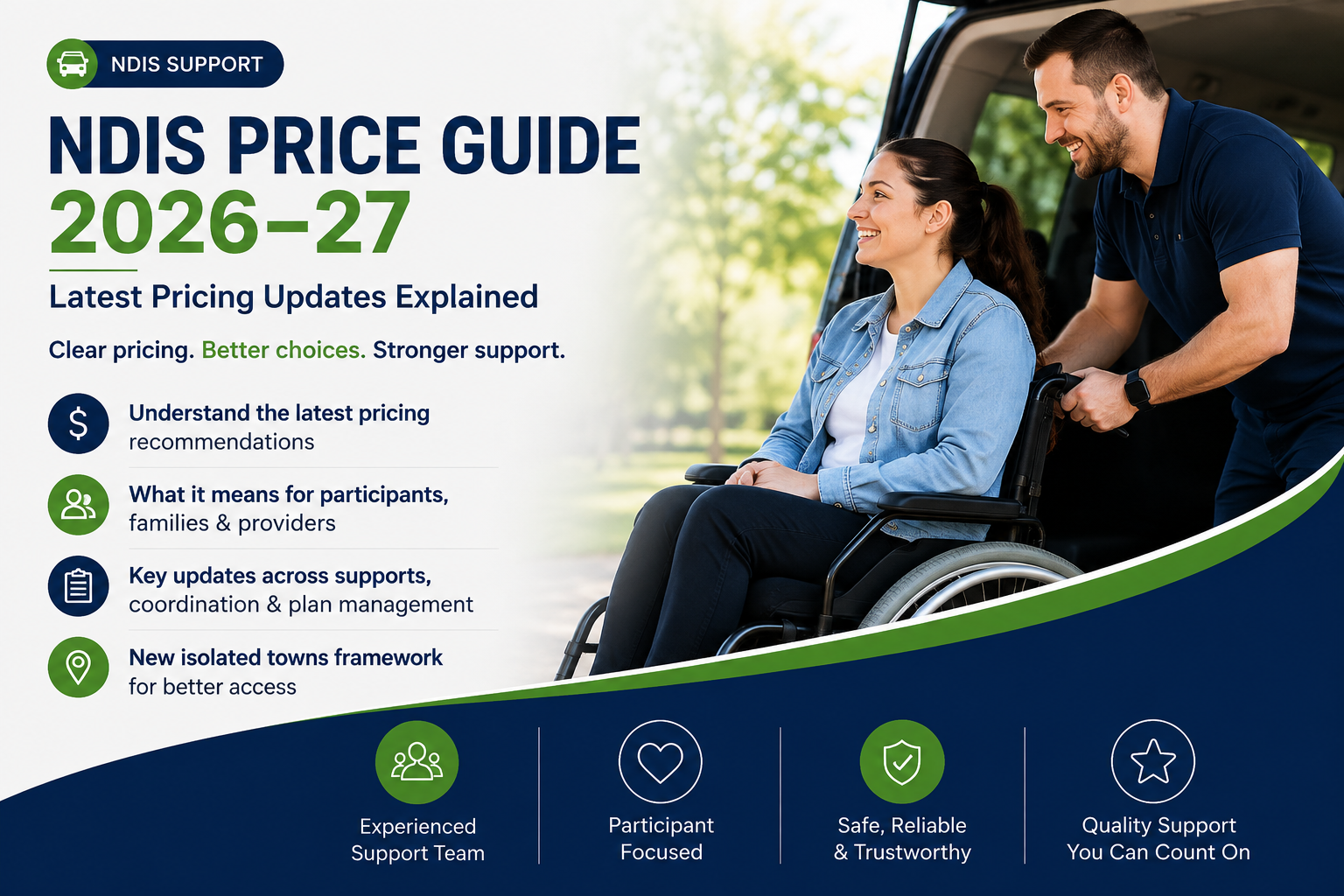
The NDIS Price Guide 2026–27 plays an important role in helping participants, providers, support coordinators, and plan managers understand how disability supports are priced under the National Disability Insurance Scheme (NDIS). It outlines the maximum price limits, pricing arrangements, and recommendations that guide how funded supports may be delivered across Australia.
The Annual Pricing Review (APR) 2026–27, published by the National Disability Insurance Agency (NDIA), examines whether current NDIS prices continue to reflect market conditions, workforce costs, participant outcomes, and provider sustainability. It also provides recommendations that may inform future pricing decisions. Importantly, the report explains that several recommendations are subject to government implementation and should not be interpreted as automatically taking effect.
Understanding these pricing updates helps NDIS participants make informed decisions about their NDIS funding, compare disability support services, and better plan for their future supports.
What is the NDIS Price Guide?
The NDIS Price Guide 2026–27 (supported by the Annual Pricing Review) provides guidance on the maximum price limits that providers can charge for many NDIS-funded supports. It is part of the broader NDIS Pricing Arrangements, which aim to balance participant choice with a sustainable disability support market.
The Annual Pricing Review is the NDIA’s primary mechanism for assessing whether NDIS prices remain appropriate. The review considers:
- Market performance
- Participant outcomes
- Workforce availability
- Provider sustainability
- Economic conditions
- Pricing consistency across the disability sector
Rather than redesigning the entire pricing system each year, the review focuses on evidence-based recommendations where changes are supported by market analysis, consultation, benchmarking, and operational data. It also forms part of the NDIA’s longer-term pricing reform program.
Why Does the NDIS Review Prices Every Year?
The disability support sector changes constantly. Rising workforce costs, inflation, labour shortages, and evolving participant needs all affect the cost of delivering quality services.
According to the Annual Pricing Review, annual pricing assessments help ensure that pricing continues to:
- Support participant access to quality services
- Reflect current workforce and wage conditions
- Maintain provider sustainability
- Respond to inflation and changing economic conditions
- Encourage a stable and competitive disability support market
The review notes that labour remains the largest cost for many disability supports. For this reason, pricing recommendations consider factors such as the Fair Work Commission’s Annual Wage Review, Wage Price Index (WPI), Consumer Price Index (CPI), and broader labour market conditions when assessing different support categories.
Key Updates in the NDIS Price Guide 2026–27
The 2026-27 Annual Pricing Review includes several important recommendations across disability support services.
| Support Area | Key Recommendation | Potential Impact for Participants |
| Disability Support Workers | Index prices using the Disability Support Worker Cost Model and Fair Work Commission wage decisions | Helps align pricing with workforce costs |
| Therapy Supports | Updated recommendations for Psychology, Dietitian, Exercise Physiology, Orientation & Mobility, and Other Professional supports | Greater alignment with broader health market benchmarks |
| Support Coordination | Recommendation to maintain current maximum prices across all three coordination levels | Continued pricing stability |
| Plan Management | Recommended monthly fee update and future review of pricing methodology | Better alignment with administrative service delivery |
| Community Participation | Proposed pricing distinction between registered and unregistered providers from January 2027 | Greater transparency while maintaining participant access |
| Isolated Towns | New Type 1 and Type 2 Isolated Towns framework | Improved support access in geographically isolated communities |
The report also recommends improvements to therapy claiming by introducing separate line items for provider travel and non-face-to-face activities, improving transparency and billing accuracy.
What These Pricing Changes Mean for Participants
For NDIS participants, the NDIS Price Guide 2026–27 is about more than updated pricing—it is about improving transparency, fairness, and long-term sustainability across disability support services.
The Annual Pricing Review highlights that participants value:
- Choice and control over providers
- Consistent, high-quality supports
- Clear pricing information
- Stable provider relationships
- Better understanding of how pricing affects available services
The review also found that many participants choose providers based on trust, experience, service quality, and continuity of care rather than price alone. While pricing recommendations may influence the disability support market, participant relationships with trusted providers remain a key factor in decision-making.
Understanding these recommendations can help participants have more informed conversations with their providers, support coordinators, and plan managers while making the most of their available NDIS funding.
Final Thoughts
The NDIS Price Guide 2026–27 is an important resource for anyone involved in the National Disability Insurance Scheme, including participants, families, carers, support coordinators, and providers. By understanding the latest pricing recommendations, participants can make more informed decisions about their NDIS funding, compare service options with greater confidence, and ensure they receive quality supports that align with their goals.
The Annual Pricing Review 2026–27 also highlights the NDIA’s commitment to maintaining a sustainable disability support sector by considering workforce costs, market conditions, participant outcomes, and provider sustainability. It’s important to remember that several recommendations outlined in the review are proposed recommendations and remain subject to NDIA or government implementation.
If you need guidance on how the NDIS Price Guide 2026-27 may affect your supports or funding, working with an experienced Registered NDIS Provider in Perth can help you better understand your plan, navigate pricing changes, and access the personalised supports you need to live more independently.
Frequently Asked Questions (FAQs)
1. What is the NDIS Price Guide 2026–27?
The NDIS Price Guide 2026–27 provides guidance on the maximum prices and pricing arrangements for many NDIS-funded supports. Supports participants, providers and support coordinators to understand the pricing of disability support services under the NDIS, and is informed by the Annual Pricing Review.
2. What are the major updates in the NDIS Price Guide 2026-27?
The Annual Pricing Review includes recommendations relating to Disability Support Worker pricing, therapy supports, Support Coordination, Plan Management, Social, Community and Civic Participation, and Isolated Towns. Some recommendations also propose improvements to therapy claiming and pricing transparency. Not all recommendations are automatically implemented.
3. How often does the NDIA review NDIS pricing?
The NDIA conducts an Annual Pricing Review each year to assess whether NDIS pricing remains appropriate. The review considers factors such as inflation, workforce costs, provider sustainability, participant outcomes, and market conditions before making recommendations for future pricing arrangements.
4. Will the NDIS Price Guide 2026-27 change my current NDIS plan?
Not necessarily. The Annual Pricing Review contains recommendations that may influence future pricing arrangements, but implementation depends on NDIA and government decisions. Participants should speak with their provider, support coordinator, or plan manager if they have questions about how any pricing changes may affect their supports.
5. How can Heed WA help me understand my NDIS funding?
As a Registered NDIS Provider in Perth, Heed WA can help you understand your NDIS funding, explain how pricing arrangements may relate to your supports, and provide personalised services such as Personal Care, Daily Living Assistance, Community Participation, Household Tasks, and Capacity Building to help you achieve your goals.
Looking for a Registered NDIS Provider in Perth?
Our experienced team is here to help you achieve your goals with personalised NDIS support across Perth.